Inside Elie Wiesel’s Papers: A Journey Through His Legacy
When one thinks of Elie Wiesel, what type of person do they think of? For many, he was the most renowned Holocaust survivor living in the United States, sharing his harrowing experience in Auschwitz and Buchenwald in his memoir, Night. To others, he was a champion of human rights, the winner of the Nobel Peace Prize, and an advocate for justice for numerous oppressed communities and people. To some, he was simply a friend. All of this is evident in his papers, which I have had the privilege of physically processing for the past year and we are making available online on the Grayzel Digital Platform, Gratz College’s new digital repository.

From Boxes to Bytes
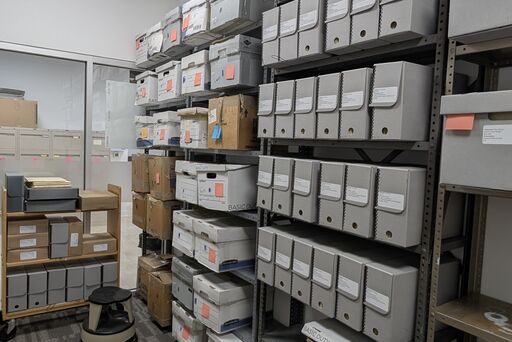
As the first digital archivist at Gratz College, I was hired specifically to work on the Elie Wiesel collection. I started by assessing the collection as a whole – what had archival value, what was garbage (an open box of crackers), and what would be sent directly on to the museum that will recreate Wiesel’s office as part of their permanent collection. Once I was able to survey the collection, I was left with 136 bankers' boxes that would need archival attention. I knew a collection of this size would require the “More Product, Less Process” (MPLP) method, otherwise we’d be working on it for years and years. MPLP is a method used by archivists to create broad groupings of items and may mean that every item is not considered. During this process, Items are rehoused in acid-free folders and boxes, to ensure greater long-term preservation. In our database, I recorded the processed material on the folder level.
Taking the time to organize the material in this way simplifies the digitization process and is an essential step for getting content ready for public access on Grayzel. This sorting process also gave me a sense of the type of content included in the collection. To my delight, I discovered many gems.

My Personal Connection

As a Jewish archivist who knew she had made the correct decision to go into the archival field after a visit to Yad Vashem, the monumentality of processing the papers of one of the most influential Jews and humanitarians of the 20th century was not lost on me. I wanted to review the materials I was working with and see if it gave me more insight into who Wiesel was as a person. Many archivists find they develop a bond with the people whose papers they process, and I have had this experience too. As I expected, there were plenty of letters from dignitaries and celebrities. Some personal favorites include a pop-up holiday card from President Barack Obama of the White House with Sunny and Bo, a Rosh Hashanah note from the actor Kirk Douglas with his name signed in Hebrew, and even a piece of the Brooklyn Bridge.
A Legacy Preserved
But what surprised me was just how many of the letters were from students and teachers writing about how his books impacted them. Many wanted to let him know that learning about his experiences as a Holocaust survivor affected them or inspired them to become history students. He would respond with a thank you note and implore them to share what they learned to prevent another Holocaust. Some people sent him headshots with requests for autographs, but Wiesel always responded that he did not sign photographs as he was not a movie star, but that he was happy to sign a copy of one of his books or send them an autographed bookplate. Despite his fame and influence, I am struck by his humility and humanity captured by his correspondence. It is a privilege to work on his personal papers, and I look forward to the public seeing a more personal side of Elie Wiesel as we continue to digitize and release this collection on the Elie Wiesel Digital Archive, part of the Grayzel Digital Platform.